Alesis HR-16
Digital Drum Machine (1987)
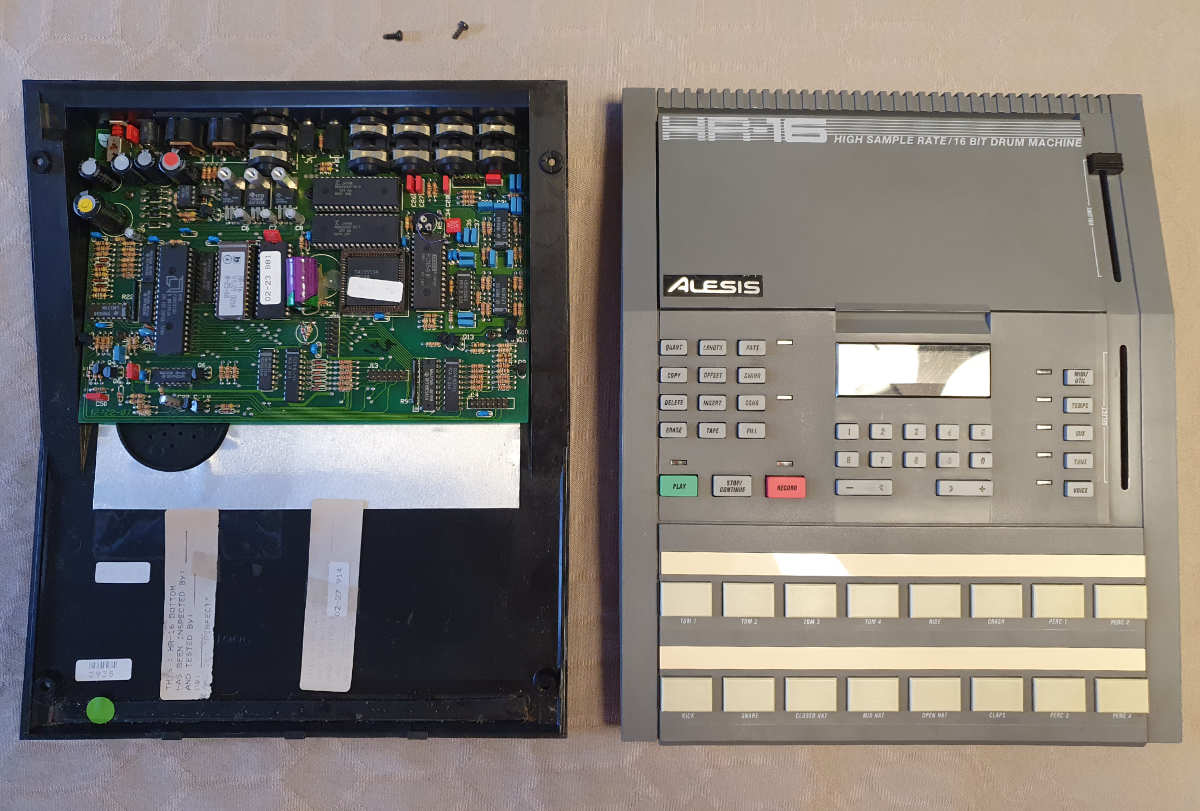
At first this machine didn't appeal to me as I didn't like the sounds. Still it is impressive for the time with somewhere up to a 50kHz sample rate and 16-bit playback.
8-Bit or 16-Bit?
While marketed as a 16-bit machine, the HR-16 stores its samples as 8-bit data. To achieve a 16-bit dynamic range, Alesis employed a "pseudo-floating point" encoding trick. As the waveform decays below a specific threshold, the encoder "shifts" the remaining audio back up to full 8-bit resolution (a process visible as the distinct 'Christmas Tree' wedges in the waveform).
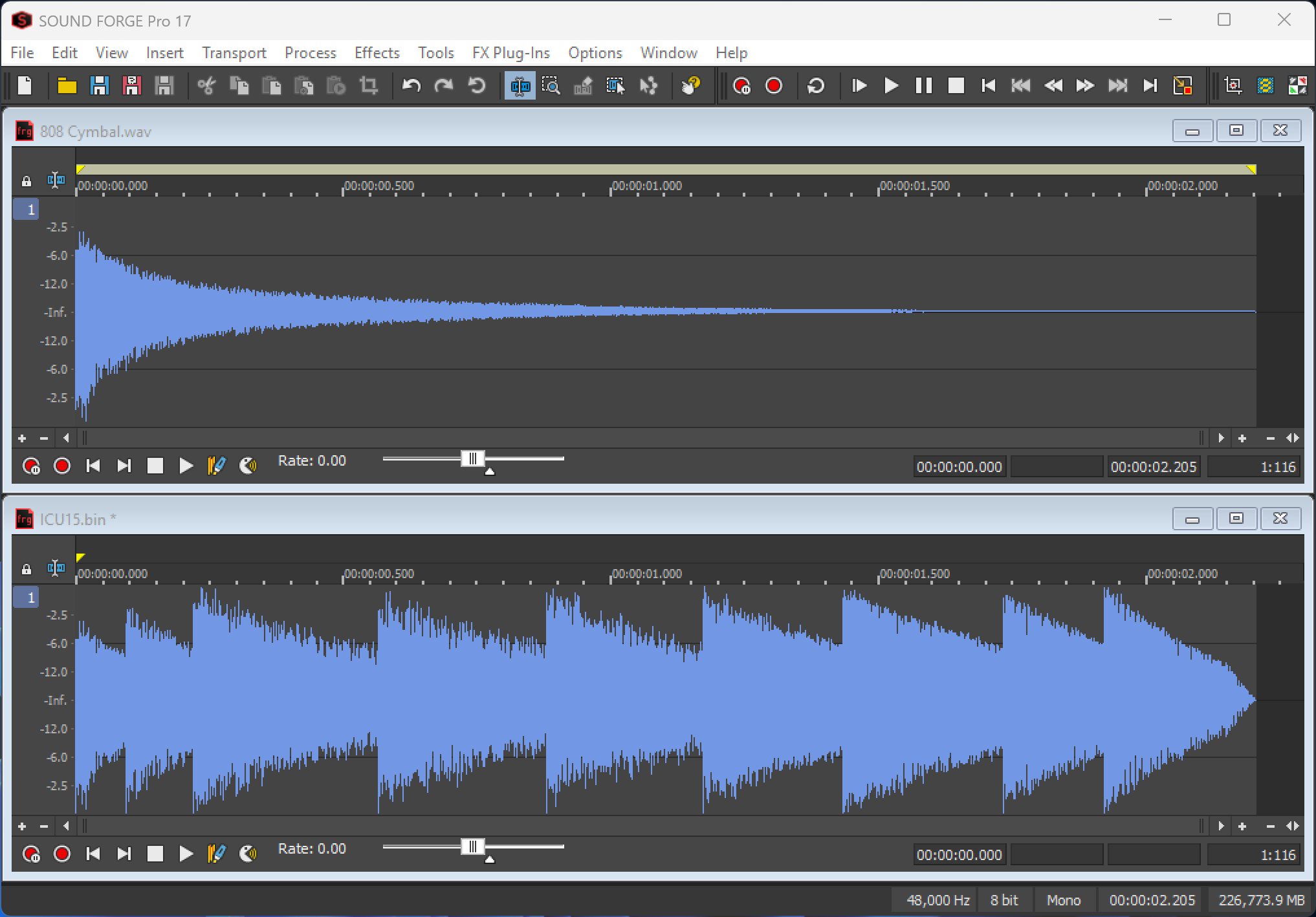
In the image above, you can see a standard 808 cymbal sample compared to the encoded version. At run-time, the HR-16's custom playback chip identifies control markers (0xFF) in the data stream. These markers tell the 16-bit shift register to drop the output volume, reconstructing the original intended volume. This allowed the machine to maintain a high signal-to-noise ratio even during quiet decays, effectively mimicking 16-bit performance using only 8-bit samples.
Custom Roland TR Soundset
I have always wanted a Roland TR-727 but have never found one at a decent price so I picked this machine up thinking that with a bit of hacking it would do the perfect job. A clever piece of software is available at sed.free.fr that performs the proper encoding and updates the OS which gives much better results than just writing regular 8-bit files over the existing samples. It turns out I could also fit a full set of TR-808 and TR-707 sounds in with the TR-727 sound set and now this thing absolutely kicks!
Download the soundset here to burn for your own machine
HR-16_TR.zipThe OS HR16B20.BIN can be burnt to a 27C256 EPROM and the sound roms ICU15.BIN and ICU16.BIN can be burnt to a 27C4001